The end of the Second World War is imagined as this clear moment which marked the end of all hostilities and the arrival of peace. The language that surrounds 1945 is saturated with a sense of finality, surrender, liberation, and, at last, peace. In retrospect, this makes for a coherent story, one that allows the war to be neatly contained within a set of dates and the decisive events that led to the Allied victory. Yet for those living through the period immediately after the fighting ceased, the experience was far less conclusive than it appears to us today, who encounter it largely through historical narratives. In large parts of Asia and Europe, the defeat of the Axis powers removed an existing structure of authority without providing a stable replacement by the Allied powers. The military victory was decisive and absolute, but the instability of the postwar political order proved far greater than wartime planning had anticipated.
 |
| Delhi Victory Week Parade - Indian Army mountain guns carried on pack mules pass the saluting base during the Victory Parade in Delhi, British India. | Imperial War Museum |
It was within this gap that British India assumed a role that has since been marginalised in most accounts of the aftermath of the war. By 1945, India had become the empire’s most dependable source of military manpower. This dependence did not recede with the end of hostilities. In fact, it intensified. Indian troops were not demobilised at scale, and were instead redeployed to regions where the conclusion of the war created power vacuums. Southeast Asia, Japan, and parts of Europe required armed presence, not for defeating an enemy, but to prevent the immediate collapse of Western colonial influence in the postwar context. Indian soldiers were sent to perform this task.
The timing of these deployments introduces a historical tension that is difficult to overlook. Between 1945 and 1947, India itself was moving through the most decisive phase of its nationalist struggle for independence. British authority within the subcontinent was growing increasingly fragile, and the inevitability of independence was widely recognised. At the same time, negotiations over the form and terms of independence continued. And yet during these same years, Indian soldiers were scattered across continents, occupying territories, reoccupying former colonies, and intervening in political crises on behalf of an empire whose legitimacy at home was rapidly eroding. This irony and contradiction formed part of the lived reality of the time.
The contradiction was especially visible in Southeast Asia. Japanese occupation had dismantled European colonial authority across the region with remarkable speed. When Japan surrendered, British, Dutch, and French administrations realised that they lacked the capacity to return and reassert control in any straightforward manner. Their military resources were severely depleted, their political authority had diminished, and nationalist movements had already established themselves as key actors in the region. Independence had been declared in many places where colonial rule had once appeared secure for the foreseeable future.
 |
| The Allied Occupation of Japan, Indian warship HMIS SUTLEJ leaves Hong Kong for Japan as part of the Allied forces of occupation. | Imperial War Museum |
Indian troops entered this landscape under the authority of the South East Asia Command. Their mandate was formally narrow and provisional, namely to accept Japanese surrender, secure ports and communication networks, and maintain order until civilian administrations could be restored. In practice, however, this meant that Indian soldiers became the most visible representatives of authority in societies that had already rejected colonial rule as illegitimate.
In Malaya and Singapore, the situation was comparatively controlled. Indian units guarded ports, secured railways, and supervised the repatriation of prisoners of war. Even here, the maintenance of order carried political implications. Stability suggested a sense of continuity, and continuity implied the return, however temporary, of colonial administration. For populations emerging from years of occupation, this was not an abstract concern.
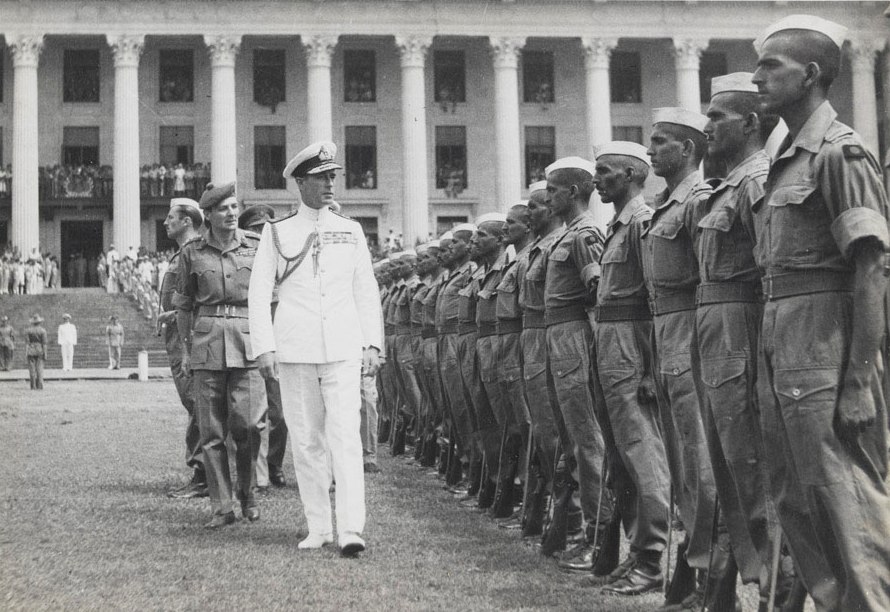 |
| Lord Mountbatten inspects the 17th Dogras after the Japanese surrender in Singapore, 1945 | National Army Museum |
In Java and Sumatra, the situation proved far more volatile. Indonesian nationalists had declared independence and regarded any reoccupation as a direct challenge to that claim. Japanese forces, still armed and awaiting disarmament, occupied an ambiguous position between defeated enemy and provisional authority. Indian troops were deployed into this unstable environment with limited guidance and very little political flexibility. Violence followed, sometimes immediately and sometimes after prolonged periods of tension. Indian casualties were a recurring feature of these operations, underscoring that this was an active and dangerous deployment rather than a merely symbolic presence.
Reducing these operations to a simple narrative of imperial policing risks obscuring their complexity. Indian troops were not sent to Southeast Asia because they opposed nationalist movements elsewhere. Many soldiers were acutely aware of the parallels between the societies they were policing and their own. Their deployment showed the exhaustion of imperial capacity rather than ideological coherence. The empire relied on Indian manpower because it had few alternatives left.
The occupation of Japan offers a different perspective though. Public memory tends to frame it as an overwhelmingly American enterprise, shaped by constitutional reform, economic reconstruction, and a single command structure. This framing, however, obscures the multinational character of the occupation. Indian troops served as part of the British Commonwealth Occupation Force and were stationed primarily in western Japan, including Hiroshima prefecture.
 |
| Indian soldiers wander in the ruins of a church in destroyed Hiroshima, June 1946. | Imperial War Museum |
Their responsibilities were largely administrative, but continuous and sustained. Indian soldiers patrolled neighbourhoods, guarded military depots, supervised demilitarisation, and maintained public order in a society still dealing with defeat and devastation. This was not a conquest in any conventional sense. It was the enforcement of stability under an emerging international framework that claimed to rest on collective responsibility instead of a unilateral imperial authority.
The consequences of this role are significant. Indian soldiers, themselves subjects of empire, were exercising authority over a defeated imperial power. They were participating in the enforcement of a postwar order even as political authority over their own country remained unresolved. India was already functioning as a global military actor before it became a sovereign one, albeit without exercising independent political will.
 |
| 5th Indian Infantry Brigade tour Acropolis after clearing Piraeus of Communist forces, Greece, 1944. | National Army Museum |
Europe, too, relied on Indian troops during the transition from war to peace. Greece provides a clear example. Following the German withdrawal, the country descended into political conflict that would later be recognised as an early phase of the Cold War. Britain intervened to prevent a political outcome it considered strategically unacceptable. Indian units formed part of this intervention.
Their tasks were again framed in administrative language, which is guarding infrastructure, securing supply routes, and patrolling urban centres, particularly in Athens. The political consequences of these actions were clear. Force was being used to intervene in postwar political situations. Long before ideological divisions were fully articulated, the practices associated with Cold War intervention were already visible. Indian soldiers were present at one of these early moments while their own country stood on the threshold of independence.
Across these different theatres, a clear pattern emerges. Indian troops were deployed during the war itself, and also redeployed to manage its consequences. Occupation, reoccupation, and intervention became the connnection between Allied military victory and the political order that followed. Without this work, surrender would likely have produced fragmentation rather than the relative stability that prevailed.
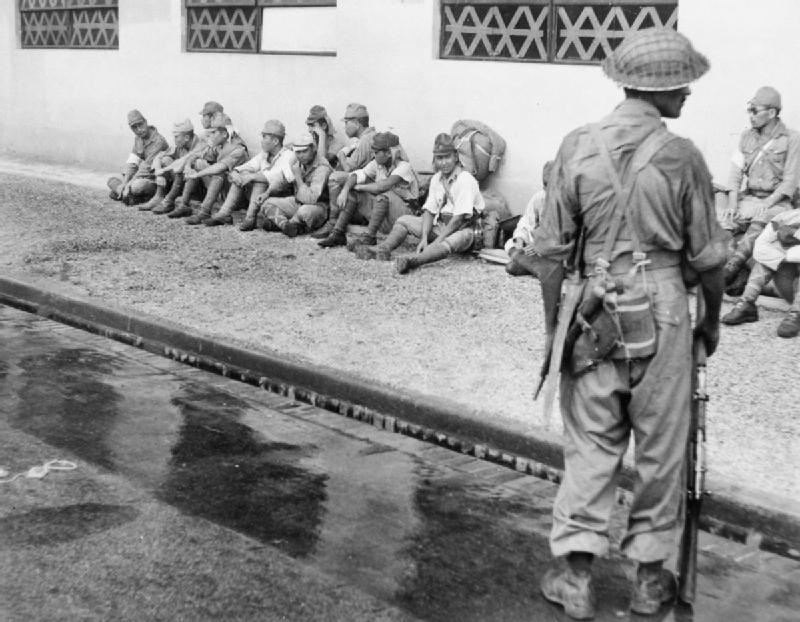 |
| A soldier from the 5th Indian Division stands guard over Japanese prisoners outside their former headquarters in Singapore, September, 1945. | Wikimedia Commons |
Recognising the role India played in these operations does not undermine the legitimacy of nationalist movements, either in Southeast Asia or within India itself. Rather, it allows for a clearer analysis of the final years of empire. The scale of coercive maintenance required after 1945 speaks to the fragility of imperial authority. Political systems that enjoyed popular consent would not have required such sustained enforcement. Indian troops were used to hold together structures that no longer rested on broad acceptance.
These experiences also influenced India in lasting ways. Soldiers returned home having witnessed European authority falter under pressure. They had seen colonial administrations retreat and negotiate from positions of weakness. The idea of empire as permanent or inevitable did not survive these encounters intact. This did not immediately politicise the armed forces in overt ways, but it eroded the assumptions that had long sustained imperial loyalty.
The relative absence of these events from public memory serves several purposes. For Britain, it avoids confronting how dependent its final years of global authority were on colonial manpower. For post-independence India, it avoids the discomfort of acknowledging how deeply Indian labour was entangled in sustaining an empire the nation had every reason to reject. Omission, however, does not clarify history. It leaves the history incomplete.
Between 1945 and 1947, the world went through a prolonged transition. Political authority survived in places, but was quite often detached from legitimacy. British India stood at the centre of this moment. Indian soldiers occupied territories, reoccupied former colonies, and intervened in political crises because empire had come to rely on them as its most dependable instrument.
 |
| Indian Independence Day celebration at British Commonwealth Occupation Force (BCOF) Base in Bofu, Japan, 15 August 1947. | Australian War Memorial |
There is a final irony worth dwelling on. The postwar international order increasingly spoke the language of self-determination and collective security. India would soon enter this world as an independent state, formally included in this new order. It did so having already borne many of the costs of stabilising that order before being fully admitted into it.
Indian nationalism did not emerge apart from these developments. It took shape alongside them, shaped by the same contradictions. The war weakened empire through defeat and through dependence on those it ruled. Once that dependence became visible, it could not be concealed again. That exposure, more than any single ceremony or declaration, helps explain why the end arrived when it did.
Comments
Post a Comment